
 2026.09.03
 Industry News
A timber fan trellis screwed to a sun-baked wall tends to fail at its weakest point first: joints open up, fixings rust and stain the render, and within a few seasons the frame pulls loose just as the climber it was meant to support finally reaches the top. An expandable garden PVC trellis is designed to avoid that failure pattern. Because its lattice is built from weather-resistant PVC strips joined at pivoting intersections, it stretches to fit the space you actually have, compresses again for storage or transport, and holds its shape outdoors without annual sanding or staining. For walls, fences, balconies, and rented gardens, it is usually the more practical option than wood or welded frames, provided you match the panel to the plant and fix it properly. This guide explains how the panels work, where they perform best, how to install one, and what trade buyers should check before ordering.
Content
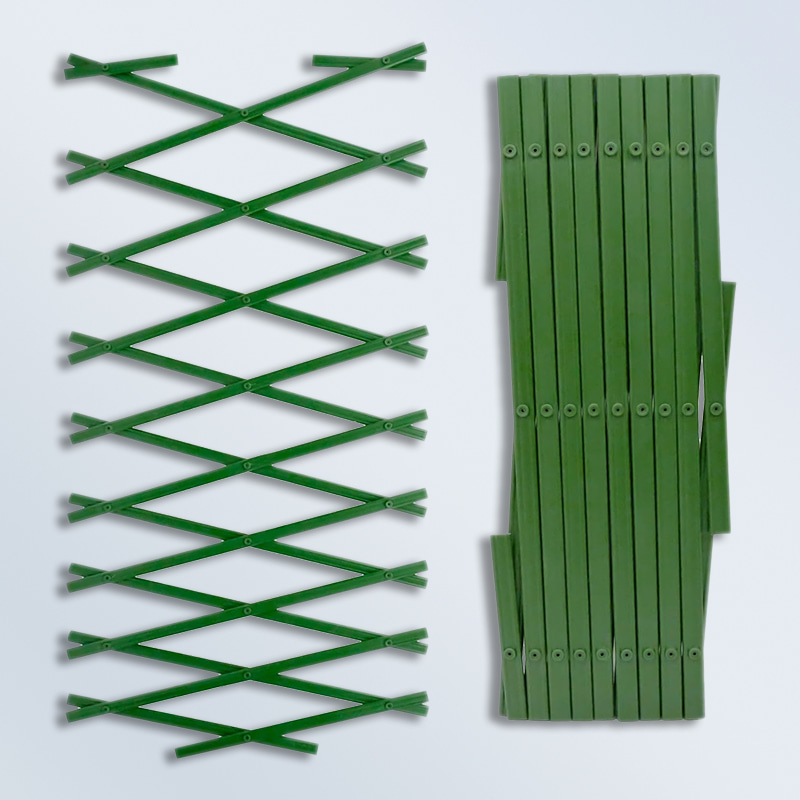
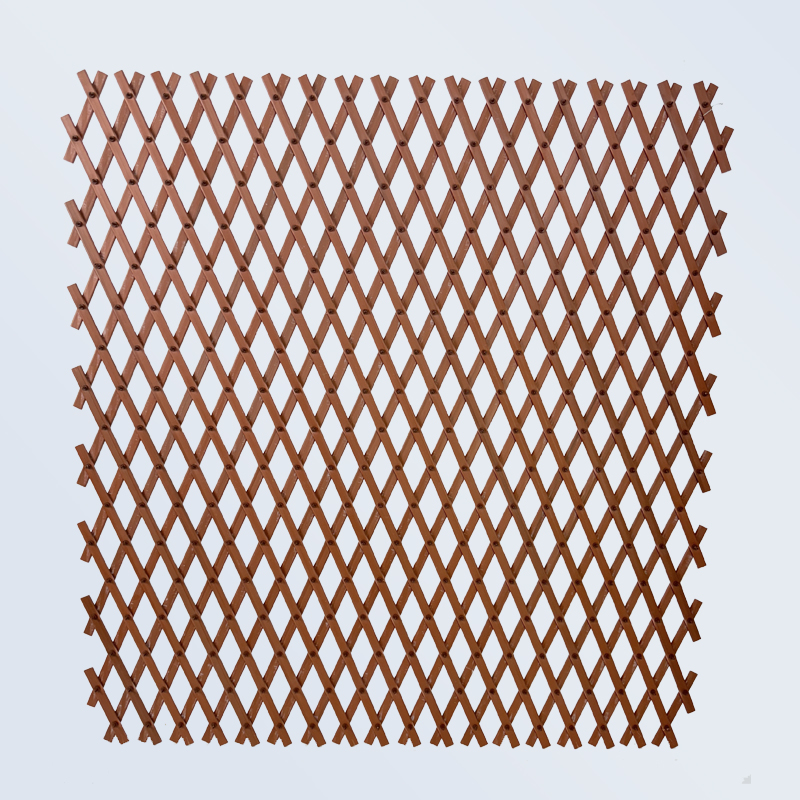
An expandable trellis, sometimes sold as an accordion or expanding lattice, is a grid of narrow strips set on the diagonal and joined at every crossing. Because those joints pivot, the whole panel behaves like a scissor grid: pull it wider and it becomes shorter, pull it taller and it narrows. That geometry is the product's core advantage. A single panel can cover a narrow strip beside a doorway or stretch across a two-meter run of fence, and it ships collapsed and flat, which keeps storage and freight costs low.
Most garden-grade panels extend to roughly 180 x 90 cm or 240 x 120 cm when fully opened, with diamond openings of about 10 to 15 cm across: large enough for flowering stems to pass through, small enough to guide young tendrils. The strips themselves are extruded rigid PVC, chosen for three practical reasons. It does not absorb water, so it cannot rot, swell, or delaminate. It is light, typically only a few kilograms per panel, so one person can handle installation. And well-made compounds include UV stabilizers that slow the chalking and surface dulling that sunlight eventually causes in any plastic kept outdoors.
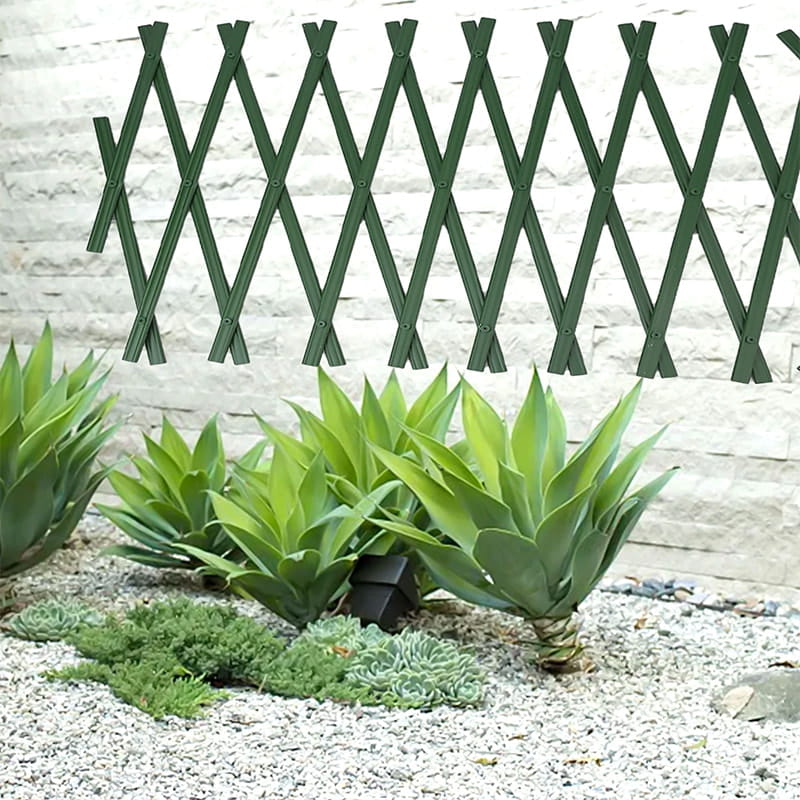 Expandable PVC Garden Trellis for Climbing PlantsA lightweight, UV-protected expandable PVC lattice that adjusts in length and shape without tools. Sized around 100–250 cm with diamond mesh openings, it suits gardeners seeking durable support that resists rot and handles seasonal expansion.View Product →
The same extrusion logic behind the lattice, meaning consistent narrow profiles produced at volume, is also why manufacturers can offer the panels in several heights, colors, and mesh densities without paying for new tooling on every variant.
Against brick or render, the panel is fixed along its top edge with screws and wall plugs, then tensioned down to a bottom fixing. A small air gap between lattice and wall, created with short stand-off blocks, keeps air moving behind the foliage and reduces damp patches on the wall surface.
On chain-link or welded mesh fencing, heavy-duty cable ties passed through the lattice intersections attach the panel in minutes, which is why the product is popular for softening an industrial boundary without rebuilding it. In exposed positions, add ties at every second or third intersection rather than relying on the corners alone.
Because a panel weighs so little and needs no ground anchor, it can be hung from a railing with ties, stretched between two walls, or taken down when the tenancy ends. Paired with a planter at its base, it turns a few square meters of balcony into a green screen.
Buyers who need coverage before any living plant can establish often choose a pre-finished version of the same idea: an expandable lattice supplied with artificial foliage already attached, ready to hang the day it arrives.
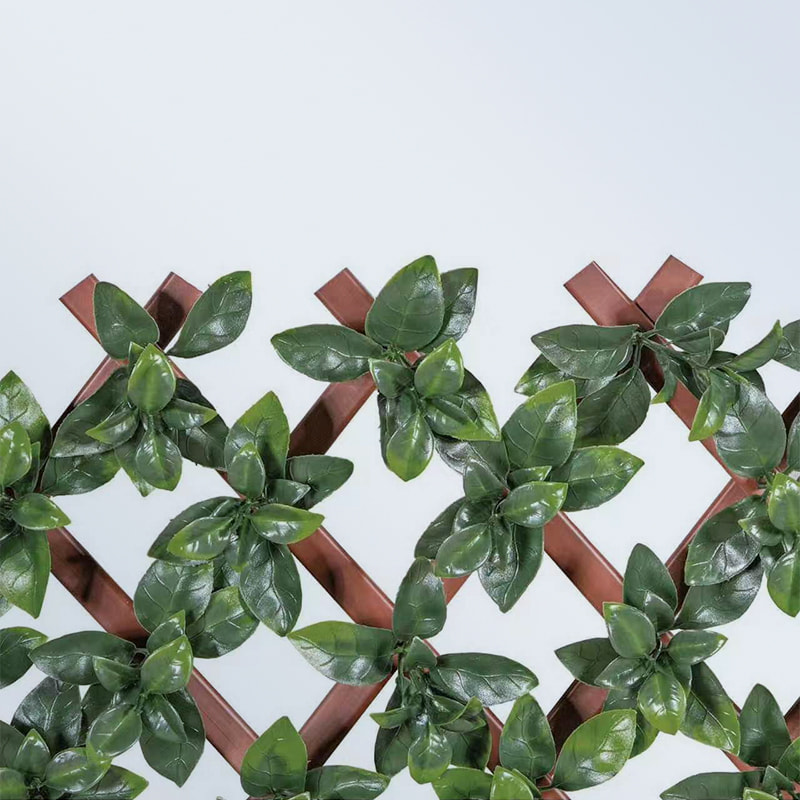 Expandable Faux Plant PVC Trellis LatticeThis version of the expandable lattice comes with artificial foliage pre-attached, offering instant greenery before climbing plants establish. Weather-resistant PVC with UV protection allows both indoor and outdoor use with no maintenance.View Product →
Material choice drives nearly every difference between trellis types, so it is worth setting the three common options side by side before deciding where an expandable panel belongs in a project or a product range.
| Aspect | Expandable PVC lattice | Timber trellis | Galvanized steel frame |
|---|---|---|---|
| Moisture behavior | Does not absorb water, so no rot, swelling, or delamination | Swells and eventually rots at soil contact and fixing points unless treated regularly | Frame resists corrosion, but cut edges and fixings usually rust first |
| Weight and handling | A few kilograms per panel; one-person installation | Moderate to heavy; two people for large frames | Heavy; requires firm structural fixings |
| Fit flexibility | Stretches or compresses to the space; ships collapsed | Fixed frame size only | Fixed; custom fabrication needed for awkward spaces |
| Upkeep | Occasional wash with soapy water | Annual staining or preservative treatment | Periodic inspection of fixings and coating touch-ups |
| Typical outdoor life | Commonly 5 to 10 or more years with a UV-stabilized compound | Often 3 to 7 years before boards warp or rot, longer with diligent care | Often 10 or more years, though fixings tend to fail earlier than the frame |
Two caveats keep the comparison honest. First, the figures assume a UV-stabilized PVC compound; a panel made from unstabilized or heavily recycled material will age noticeably faster in strong sun. Second, no material survives bad fixings: rusted screws and undersized anchors shorten the life of any trellis, whatever it is made of. For readers comparing a wider range of garden materials on lifespan, cost, and weather resistance, this garden fence material guide sets out the practical trade-offs in detail.
The installation mistakes that matter most are fixing too few points and ignoring wind load. A mature climber caught in wet wind weighs far more than the panel itself, and the fixings, not the lattice, take that load.
Diamond openings of 10 to 15 cm suit most common climbers, but plant type still decides whether a panel thrives or disappoints. Twining plants such as beans, morning glory, and honeysuckle wind naturally around the strips and need almost no help. Tendril climbers, including sweet pea and clematis, grip the strips readily as long as the stems can reach the next crossing. Self-clinging climbers such as ivy will cover the lattice but need trimming where they creep onto render or brickwork. What the panel cannot do is carry heavy woody mass: a mature wisteria or an established climbing rose needs a purpose-built frame, with the PVC lattice used, if at all, as a decorative face in front of it.
Panels that disappoint in their second season usually fail for one of three reasons: the compound lacked UV stabilization, the joints were under-built, or the strips were too thin for the panel size. Distributors, landscape contractors, and procurement teams can screen out most of those problems with a short checklist.
The material question also has a polypropylene dimension. PP profiles behave differently from PVC in temperature extremes and chemical exposure, and the same logic that separates PP and PVC privacy fence strips applies when choosing profiles for trellis production. Retailers building a garden category around the trellis often stock it beside adjacent screening lines as well; a 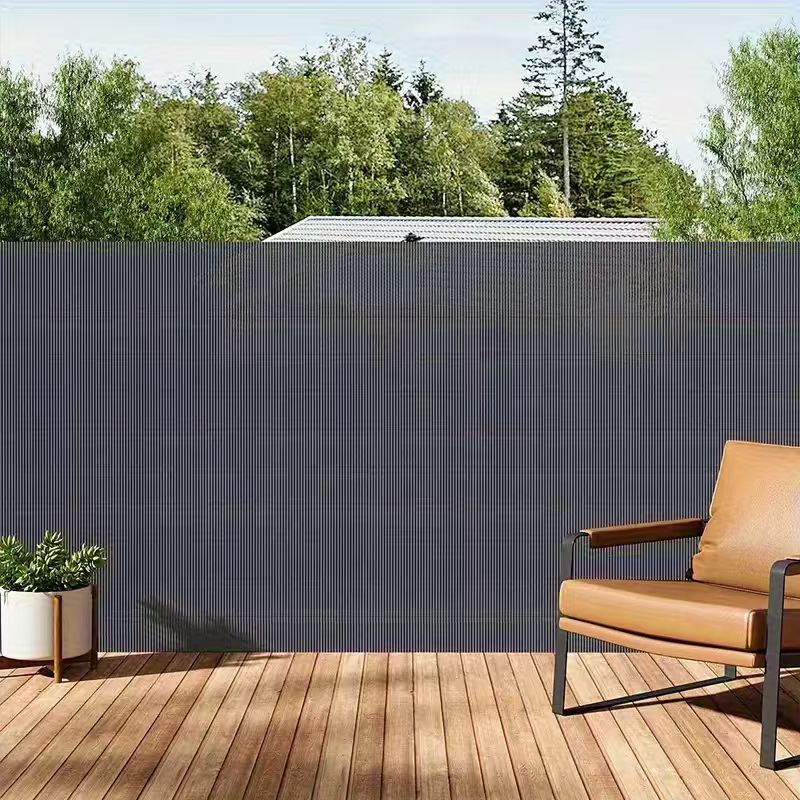 Artificial PVC Bamboo Screening FenceBrushed and woven PVC panels replicate natural bamboo's texture while providing waterproofing and mold resistance. Retailers often stock it beside expandable trellises, since both cover instant privacy demands that living plants cannot meet in their first season.View Product → covers the instant-privacy demand that living plants cannot meet in their first season, and the two products share the same freight and display logic.
An expandable PVC trellis will never out-lift a steel frame, and it does not need to. Its value lies in fitting awkward spaces exactly, ignoring rain and rot, and arriving flat in quantities that make sense for a single balcony or a full container alike. Choose a UV-stabilized panel, fix it generously, match it to plants that suit its strength, and it will quietly do its job for years while the garden grows over it.

 +86-18267317201
 +86-572-2373931
 [email protected]
 1411 Building 1,No.1969 Chuangye Avenue, Huzhou City ,Zhejiang Province, China.
 | Login


 Español
  Deutsch