
 2026.11.17
 Industry News
Content
A privacy slat that creeps 40 mm out of the mesh in its first hot summer has already failed, and the failure almost always starts at the bottom end. The lock foot is the only part of the slat that fights gravity, wind uplift and thermal movement at the same time, which is why a custom bottom locking privacy slats manufactory spends more tooling hours on 30 mm of foot than on 1,800 mm of body.
Buyers who order slats by colour and length alone usually come back with a complaint six weeks after installation. The numbers that decide fit are width, wall thickness, foot opening and cut length, and every one of them carries a tolerance that has to be agreed before the die is cut. What follows is a working specification guide for custom bottom locking privacy slats: the geometry, the polymer choice, the extrusion stages, and the container arithmetic that sets your landed cost.
A bottom locking privacy slat is a vertical polymer profile woven through chain link mesh whose lower end carries an integral lock foot, a hook, tab or flared shoulder that traps the bottom rail or tension wire so the slat cannot ride upward.
Working definition: the lock foot is the formed section at the base of the slat, normally 20 mm to 45 mm tall, with an internal opening sized to the outside diameter of the bottom rail plus 0.5 mm to 1.0 mm of clearance.
Two bottom rails dominate the market: 34.9 mm (1-3/8 in) and 41.3 mm (1-5/8 in) outside diameter pipe, consistent with the rail and tension-wire practice described in ASTM F567. Tension-wire bottoms use 3.76 mm (9 gauge) or 4.51 mm (7 gauge) galvanised wire. A foot drawn for the 41.3 mm rail will not grip a 3.76 mm wire, because the opening ends up roughly 38 mm too wide and the slat slides out of the panel in the first storm. Send the rail drawing with the enquiry, not the nominal pipe size.
Those three figures run through every decision below: weight per metre, movement per degree, and the tolerance band a profile line can actually repeat.
Six dimensions decide fit on a custom bottom locking slat: width, overall length, wall thickness, lock-foot opening, foot height and cut squareness. Each one needs a tolerance on the drawing, because a slat 0.5 mm too wide will not pass a 50 mm diamond, while one 0.5 mm too narrow drops through the mesh during installation.
| Dimension | Typical range | Tolerance | Failure if missed |
| Slat width | 4.0 mm to 8.0 mm | +/- 0.25 mm | Jams in 50 mm mesh or rattles loose |
| Overall length | Fabric height minus 30 to 40 mm | +/- 1.5 mm | Slats bow the bottom rail or leave a finger gap at the top |
| Wall thickness | 0.8 mm to 1.4 mm | +/- 0.10 mm | Thin walls ovalise in heat, thick walls add freight |
| Lock-foot opening | Rail OD plus 0.5 to 1.0 mm | +/- 0.30 mm | Foot will not seat, or releases under wind uplift |
| Foot height | 20 mm to 45 mm | +/- 0.50 mm | Foot slips under the rail on uneven ground |
| Cut squareness | 1.5 mm per 1,000 mm | +/- 0.50 mm | Ends hang below the rail line |
Length deserves its own arithmetic. For a 1,830 mm (6 ft) fabric height, cut slats at 1,790 mm to 1,800 mm, because the 30 mm to 40 mm difference absorbs the bottom rail, the lock-foot bend and the top selvage. Slats cut to the full fabric height bow the bottom rail and stand proud of the top wire, which is the single most common complaint on a first delivery.
Thermal slack, not length, is what keeps a lock foot seated. At a coefficient of linear expansion near 150 x 10^-6/K for polypropylene and 55 x 10^-6/K for rigid PVC, a 1,800 mm slat moves about 10.8 mm and 4.0 mm respectively across a 40 K surface swing. The foot slot therefore needs at least 12 mm of vertical clearance in PP and 6 mm in PVC.
Rigid PVC holds a tolerance line better than polypropylene, while PP survives chemistry and cold impact better. The density gap decides freight: rigid PVC sits between 1.38 g/cm3 and 1.42 g/cm3 while PP runs 0.90 g/cm3 to 0.91 g/cm3, so an identical profile in PP weighs 35% less per metre.
The trade-offs are set out in more depth in this PP versus PVC privacy slat comparison, including surface finish options and colour matching under a 1,000 hour QUV test to ASTM G154.
Geometry decides how a panel reads from the street, and three profiles cover most custom requests, all of them toolable with the same lock-foot family. Width should be matched to mesh size first: 4 mm to 5 mm slats suit 50 mm diamonds, while 6 mm to 8 mm slats fill 57 mm and 63.5 mm mesh without binding.
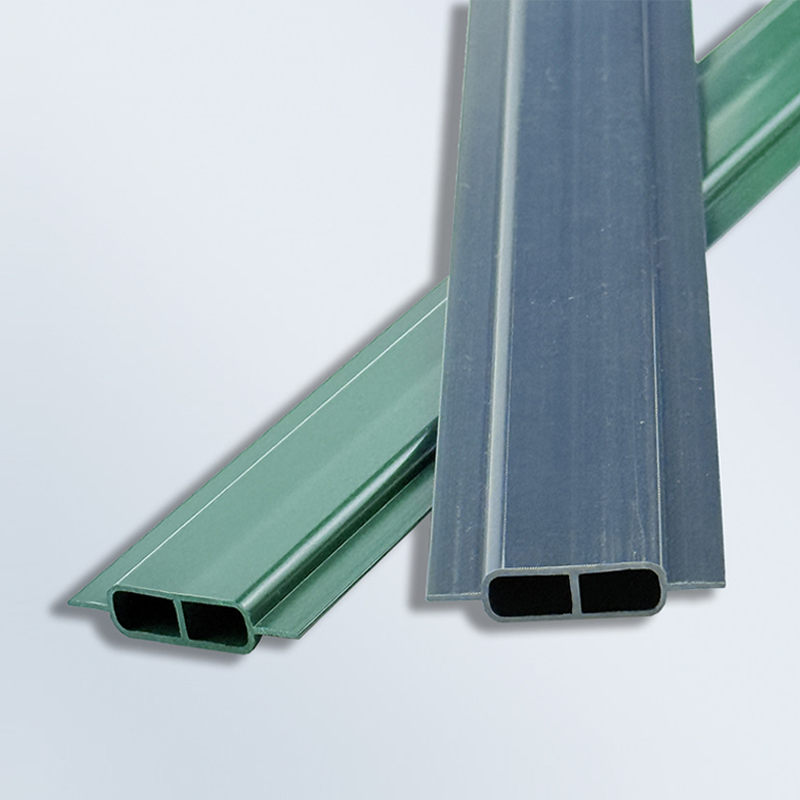
A longitudinal ridge adds stiffness without adding wall, so a 0.9 mm ridged profile behaves like a 1.2 mm flat one in wind. This is the default choice for 1,500 mm and 1,800 mm residential panels where cost per metre matters more than visual density.
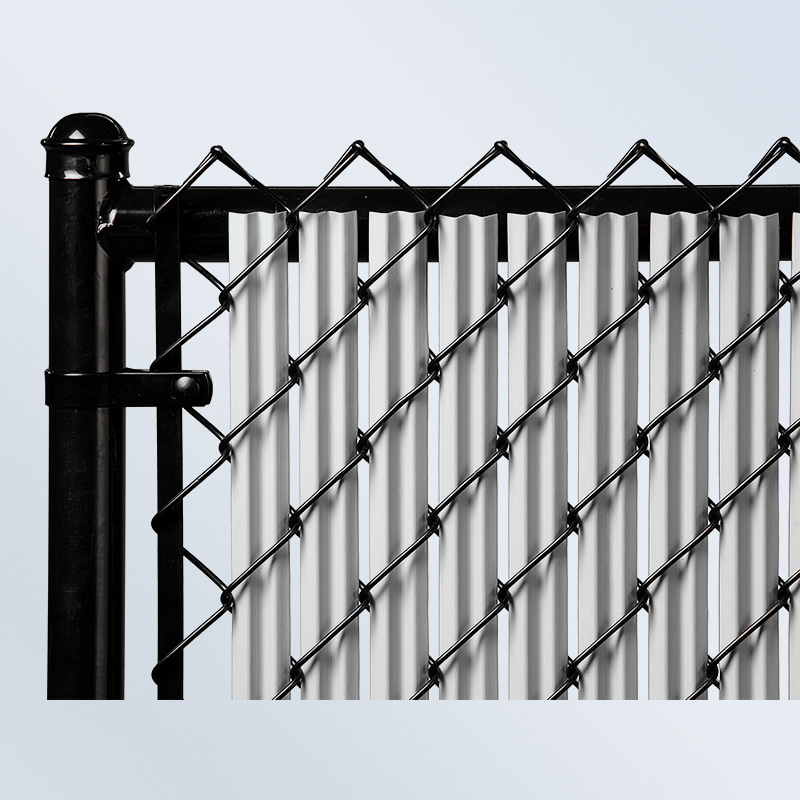 DAYOU Privacy Ridged PVC Slats for Chain Link FencesRidged PVC slats add stiffness for residential chain link panels, with UV resistance and a snap-in bottom channel for quick installation.View Product →
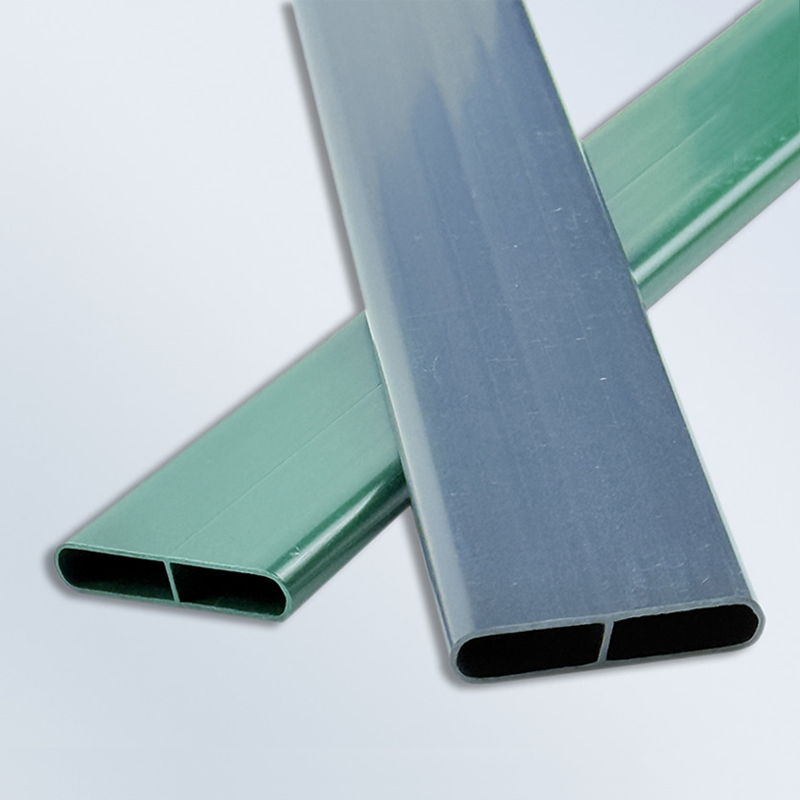
A closed tube reads as a round vertical line and screens more of the diamond than a flat strip of the same width. Tube geometry needs a slightly larger lock foot because the wall collapses less under load, and it is the profile most often specified for commercial and sports-ground fencing.
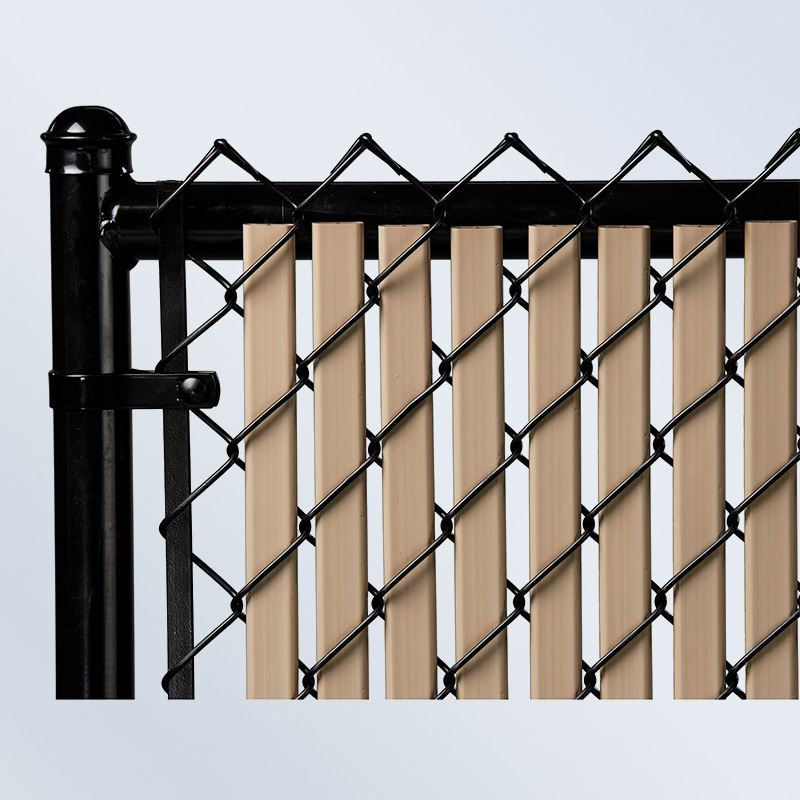 DAYOU Privacy Tube PVC Slats for Chain Link FencingClosed PVC tube slats screen more of the chain link diamond and suit commercial or sports-ground fencing needing privacy, wind resistance and simple snap-in installation.View Product →
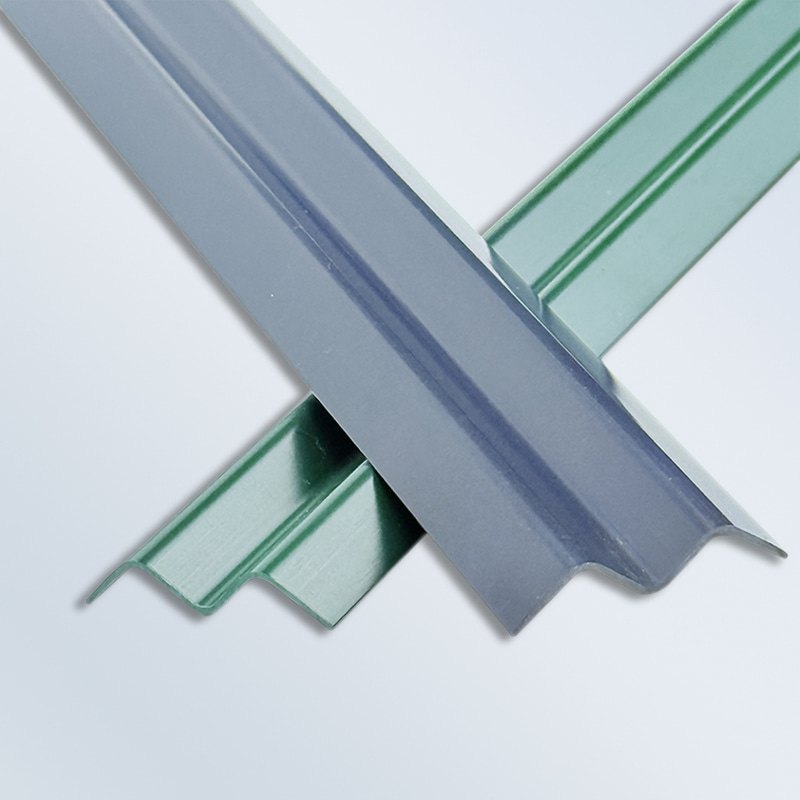
Woven flat tape gives the tightest visual block per kilogram and is the cheapest way to raise privacy on an existing fence. It relies on the same bottom lock principle, but the foot is a folded loop rather than a moulded shoulder, so the slot tolerance tightens to +/- 0.20 mm.
 DAYOU Winged PVC Privacy Slats for Chain Link FencesWinged PVC inserts add privacy and UV resistance to chain link fences; vacuum calibration and foot forming are key production stages for consistent slats.View Product →
Six stages take a drawing to a sealed carton, and two of them decide your reject rate: vacuum calibration and foot forming. Everything upstream is preparation, everything downstream is packing.
A wall that drifts 0.05 mm on a 1,800 mm slat changes the carton weight by roughly 1.5 kg per 100 pieces, which is enough to flip a full container from volume-limited to weight-limited.
Zhejiang Huzhou Dayou Plastic Technology Co., Ltd. (Dayou Plastic) runs extrusion, injection and clip production on one site, which keeps a slat order, its mounting clips and a matching cutter in the same shipment instead of three.
A 40 ft high-cube carries about 76 m3 and roughly 26,500 kg of payload, and cartoned hollow slats normally fill the box long before they reach the weight limit. Profile wall thickness is a bigger cost driver than polymer density on any volume-limited order.
| Container | Internal volume | Typical payload | What limits the load |
| 20 ft GP | 33.2 m3 | 28,000 kg | Volume for hollow slats, weight for solid strip |
| 40 ft HQ | 76.3 m3 | 26,500 kg | Volume in almost every slat shipment |
Practical consequence: shrinking a carton by 40 mm on each side and nesting feet end to end can add several hundred linear metres to a 40 ft load, while a denser compound adds cost without adding metres. Ask for the packed carton dimensions and the net weight before you compare two quotations, because price per metre and price per container rarely rank the same suppliers in the same order.
76 m3 against 26,500 kg: cube, not weight, limits most custom bottom locking slat shipments, so carton design is a cost line, not an afterthought.
Five items on the purchase order prevent nearly every claim that follows a first container. Each one costs nothing to write and a lot to fix later.
Cut to the fabric height minus 30 mm to 40 mm, held to +/- 1.5 mm. A 1,830 mm (6 ft) panel therefore takes 1,790 mm to 1,800 mm slats, which leaves room for the bottom rail, the lock-foot bend and the top selvage without bowing the frame.
Size the opening at the rail outside diameter plus 0.5 mm to 1.0 mm, and add vertical slack of at least 12 mm for PP and 6 mm for rigid PVC. Those figures come from expansion of about 150 x 10^-6/K and 55 x 10^-6/K on a 1,800 mm slat across a 40 K swing.
Rigid PVC with titanium dioxide pigmentation holds colour beyond 10 years on most exposures, while PP is the stronger choice near salt water, fertiliser stores and animal enclosures. Specify a UV package tested to ASTM G154 for 1,000 hours with a colour shift of 3 Delta E or less, and insist on the test report with the first shipment.
Tooling is charged once per cross-section, so the practical minimum is the smallest run that amortises the die. Ask for the die cost, the setup charge and unit prices at 5,000 m, 20,000 m and one full 40 ft container before you commit, because the price curve flattens sharply after the second container.

 +86-18267317201
 +86-572-2373931
 [email protected]
 1411 Building 1,No.1969 Chuangye Avenue, Huzhou City ,Zhejiang Province, China.
 | Login


 Español
 Deutsch