
 2026.11.10
 Industry News
Content
This dossier is written for procurement and technical teams comparing a custom expandable PVC lattice manufactory with a trading company. The useful comparison is not catalogue width. It is tooling ownership, compound control, hinge capability and the evidence supplied before a purchase order is released.
A custom expandable PVC lattice manufactory controls five variables that decide opening force, squareness and outdoor life: compound grade, profile wall, hinge web, cell geometry and clip interface.
The extrusion die sets the outer envelope. The calibrator controls wall concentricity. The hinge web is a thin section that must stay flexible without stress whitening. Molded clips then lock the lattice to a wall, post or frame. A trader can quote a price, but cannot change a hinge radius without a die and a first-article sample.
| Variable | Practical range | Purchasing note |
| Expanded length | 600 to 1,800 mm | Match fixing centers, not only the catalogue size |
| Cell opening | 50 to 150 mm | Smaller cells need more hinge travel |
| Wall thickness | 1.4 to 3.0 mm | Thin walls reduce weight and stiffness |
| Hinge web | 0.6 to 1.2 mm | Set a tolerance of plus or minus 0.2 mm |
| Clip interface | Project-specific | Confirm screw boss, snap fit and pull-off |
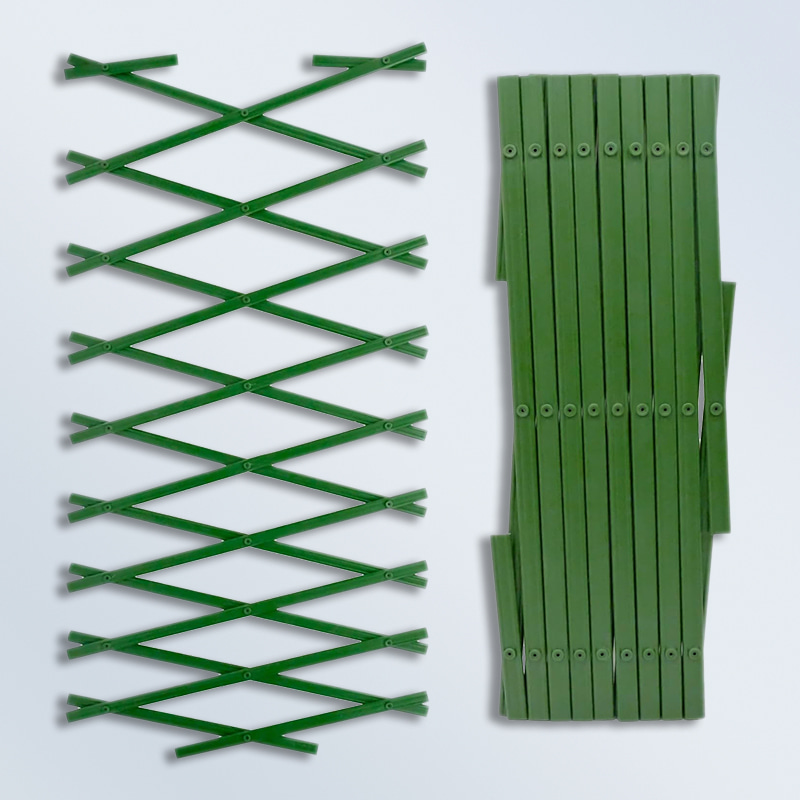
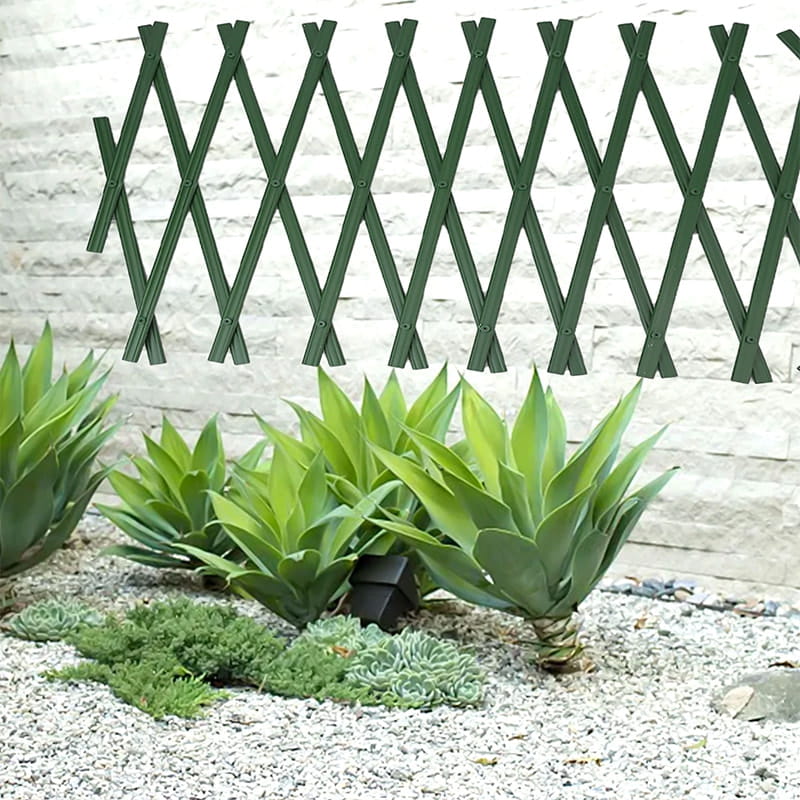 Expandable Garden PVC Trellis Lattice by DAYOUFlexible hinged PVC lattice with multiple expanded sizes and colors for garden plant support, where first-article clip fit can be assessed.View Product →
For a garden program, the first article should open across the full stroke with the production clip fitted. A lattice that works on a bare extrusion but binds after assembly has a clip-interface problem, not an extrusion problem. Test the system as the customer will install it.
Rigid PVC is the default for a painted or woodgrain lattice because it gives higher stiffness at a lower wall thickness. PP is the better choice when a project needs a higher continuous service temperature or a fully pigmented through-color surface.
Unplasticized PVC compound to ASTM D1784 sits in a density range of 1.38 to 1.45 g/cm3. Its coefficient of linear thermal expansion is roughly 50 to 80 micrometers per meter per Kelvin, so a 1,200 mm panel may move 2 to 3 mm across a 30 C swing. Design slotted fixings and avoid tight holes that clamp the lattice.
High stiffness at 1.4 to 2.4 mm wall. Accepts paint, laminate and woodgrain. Needs a UV stabilizer package. Solvent welding and clips both work.
Moderate stiffness with better heat resistance. Pigment runs through the section. Needs a hindered amine light stabilizer package. Snap-fit assembly suits hinge products.
UV performance is not a single additive. Require ISO 4892-2 xenon-arc or ASTM G154 data on coupons cut from the production color and wall. A 2,000-hour result with Delta E at or below 3 is a credible outdoor benchmark, but the test report must identify resin grade, stabilizer package and test conditions.
Tooling release should be gated by a first-article report that measures hinge web, wall thickness, cut length and clip retention on the same 30-piece sample.
A custom profile program starts with a 2D drawing that fixes expanded length, collapsed length, cell geometry, fixing centers, color and clip part number. The die and calibrator then control wall balance. Without a signed drawing, a 0.3 mm change in hinge web becomes a commercial argument after shipment.
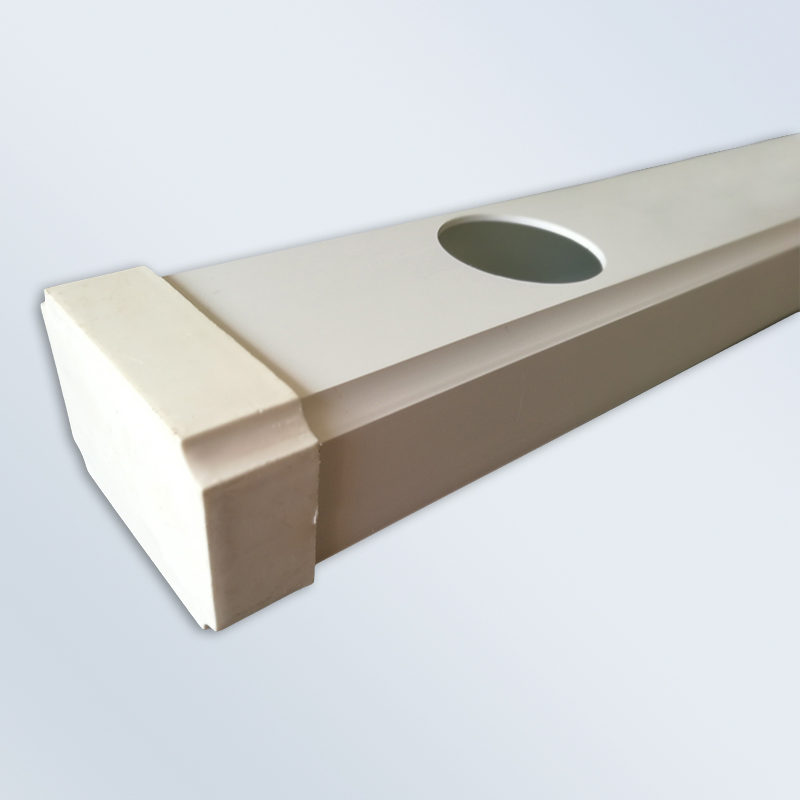
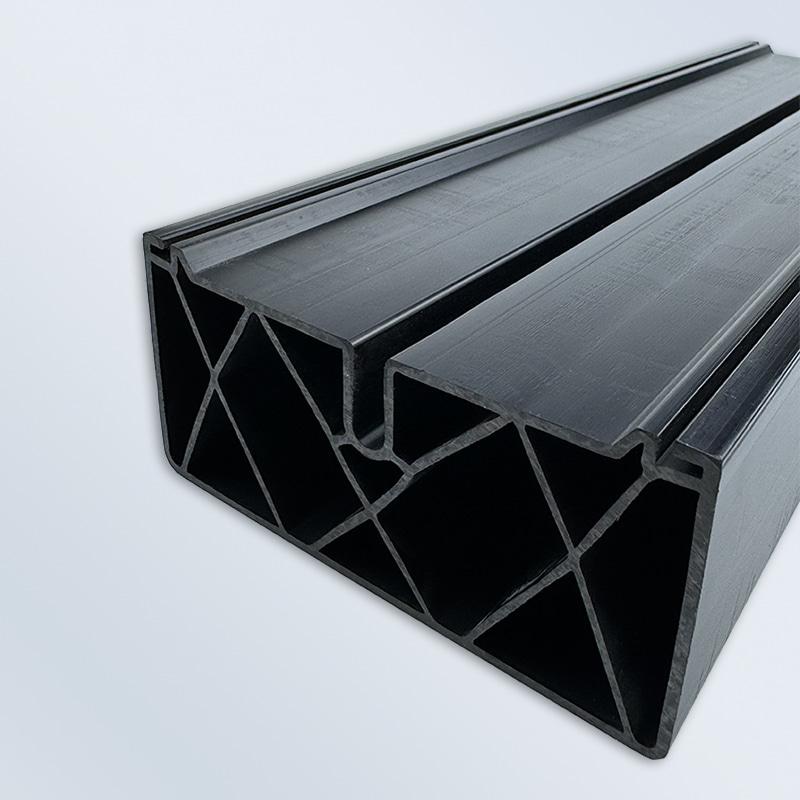 Custom PVC Profile by DAYOUCustom virgin PVC profiles with adjustable cross-sections, colors, and hardness, suitable for matching lattice clips, cores, or secondary extrusions in one tolerance chain.View Product →
At Zhejiang Huzhou Dayou Plastic Technology Co., Ltd., the custom profile line covers PVC, PE, PP and ABS. That range matters when a lattice needs a matching clip, core or secondary extrusion. The useful question is not whether a supplier lists custom profiles, but whether it can keep the hinge web and clip fit inside one tolerance chain.
A 1,200 mm expandable lattice needs a fixing zone that allows 2 to 3 mm of thermal movement and a clip spacing that keeps the hinge web straight under load.
Fix the outer frame first, then open the lattice to the required width before tightening the intermediate clips. A panel forced into position will bow at the hinge and lose cell registration. On masonry, use a slotted bracket or a washer with clearance rather than a fully clamped screw.
Use the chart as a starting point for a decorative screen, not as a structural rating. Wind load, fixing height and clip spacing still govern the final wall. The practical fit and installation sequence is covered in this guide to expandable garden PVC trellis systems.
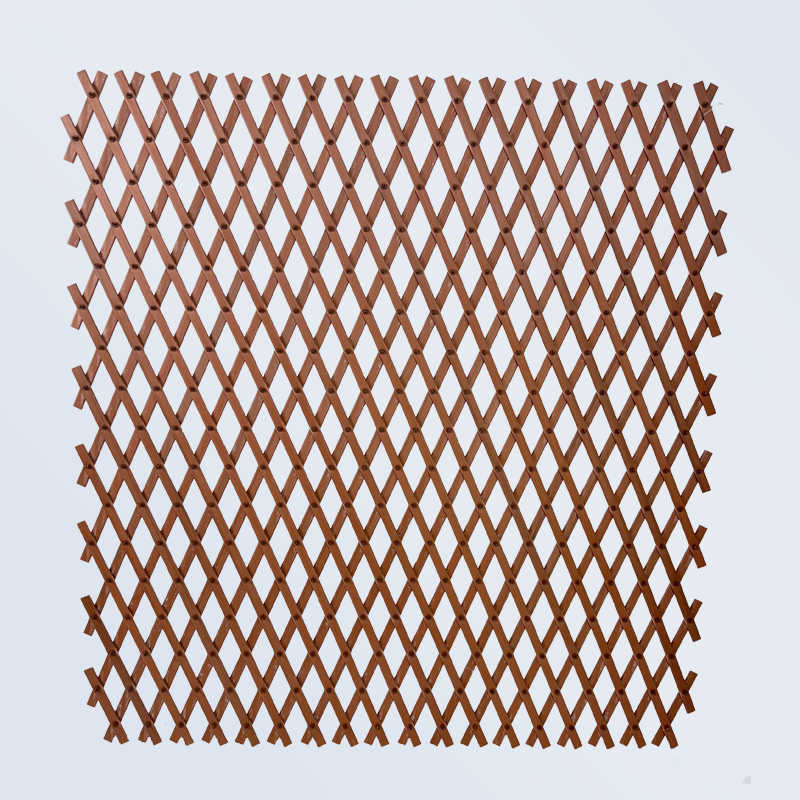
 Expandable PVC Faux Plant Trellis LatticeFlexible hinged PVC lattice for faux-plant green walls and privacy screens, with multiple extended sizes and colors for decorative indoor or outdoor use.View Product →
For a faux-plant facade, reduce cell size and increase clip density. The lattice carries less wind load than a solid panel, but the open cells catch foliage and debris, so the fixing detail must allow cleaning and replacement without removing the whole frame.
A factory audit for expandable PVC lattice should verify four items in production: compound batch records, hinge-web measurement, clip pull-off and packed bundle squareness.
In-house clip molding is a real advantage because the clip can be adjusted to the extrusion rather than the reverse. The same logic applies to cutting tools and core holders: a manufactory that controls the accessory interface can close tolerance gaps that a reseller cannot see.
Four checks settle the specification disputes that appear after a die is cut and a container is loaded.
Expanded length, collapsed length, cell opening, wall thickness, hinge web, fixing hole diameter and clip part number. Add the allowed thermal movement at each fixing and the packed bundle mass. A drawing without hinge tolerance is a concept, not a purchase specification.
Use ISO 4892-2 xenon-arc or ASTM G154, with coupons cut from production color and wall. Set 2,000 hours and a Delta E limit of 3 for color, plus a tensile or impact retention limit agreed before testing. A generic UV label is not evidence.
Measure 30 pieces per lot at three points along the hinge with a profile projector or vision system. Record minimum web, maximum web and range. The range matters more than the mean because a tight average can still contain a stiff panel.
Ask for three numbers: tooling amortization, minimum extrusion batch and minimum assembly batch. For a 1,200 mm lattice, a 500 kg extrusion run is a practical starting point, while assembly MOQ depends on clip type and packing. Do not accept one blended MOQ without the split.

 +86-18267317201
 +86-572-2373931
 [email protected]
 1411 Building 1,No.1969 Chuangye Avenue, Huzhou City ,Zhejiang Province, China.
 | Login


 Español
 Deutsch